- More
Online Report 10 Oct 2025 , 9:36 AM Print Edition
Dhaka has never stood still. It has grown, shifted, and reinvented itself through the rise and fall of empires, the flow of trade, and the everyday lives of its people.

One can read its story in history books, but perhaps more vividly, can see it on canvas – in paintings that hold the city’s memories, moods, and transformations.
From the grandeur of the Mughal courts to the tangled alleys of today’s Old Dhaka, every brushstroke tells a new version of the same city.
Its rivers and streets are alive with movement, its rhythm changing with time, yet constantly, unmistakably, Dhaka.
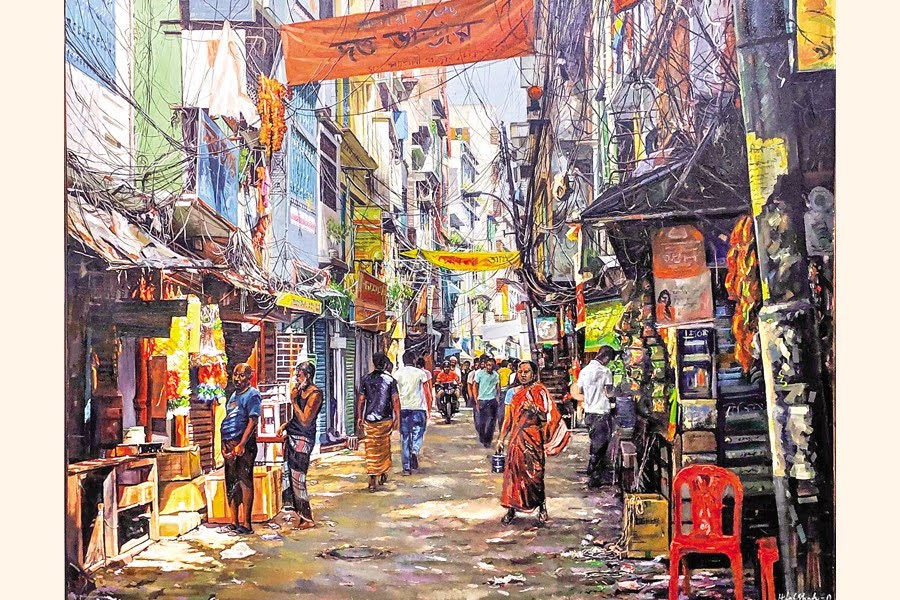
For contemporary artist Helal Shah, the city is not a distant subject of grandeur or decay, but rather an integral part of his daily life and artistic practice.
“My artistic journey with Dhaka didn’t begin poetically; rather, it was a natural part of an ongoing process,” he says. “My university campus was nearby, and some of my seniors were already working on Old Dhaka as a subject. For these reasons and a few others, I gradually began working in that area.”
In the Mughal era, Dhaka was a city of waterways, its identity closely tied to the Buriganga and the network of canals that connected the settlement.
Painters of the time, influenced by Mughal miniature traditions, captured palaces, mosques, and gardens along glistening riverbanks. Boats of all shapes and sizes, carrying goods, traders, and passengers, filled their canvases.
These early paintings presented Dhaka as a flourishing provincial capital. Its waters shimmered under domes and arches, while the bustling ports reflected the pulse of trade and life.
Then came the British colonial gaze. When the East India Company expanded its influence over Bengal in the 18th and 19th centuries, Dhaka’s image underwent a significant transformation. The city, as painted by colonial artists, became an object of fascination, documented, categorised, and romanticised.
Artists like Sir Charles D’Oyly and Johann Zoffany often painted ruins and fading Mughal monuments, presenting Dhaka as a place that had outlived its glory. They focused more on the water sides of Dhaka, such as the bank of the Buriganga River or the canal beside the Wari Christian cemetery, built in 1600.
The Watercolour sketches of the Buriganga from that time show palatial European houses on one side and the humble boats of native workers on the other, a visual contrast between power and poverty, control and chaos.
Dhaka became both exotic and subdued under the imperial brush, its people reduced to figures within a picturesque backdrop. But the city didn’t fade away inside colonial frames. It moved forward – expanding, crowding, rebuilding itself.
The canals that once defined Dhaka narrowed as urban sprawl took over, and colonial roads cut through its older quarters.
Painters who followed captured a Dhaka caught between two worlds – river and road, memory and change. A young artist puts it, “When I sit by the Buriganga to paint, I don’t see ruins or decay as colonial artists did.
I see movement-the sweat of labourers, the hope of passengers, the chaos that defines us. That is Dhaka’s truth.”
From the launch terminals of Sadarghat to the tangled alleys of old Dhaka, a city painted not from nostalgia, but from familiarity.
“From my very first year, I started going to Old Dhaka to paint,” Helal recalls.