- More
Khaled Saifulla 11 Dec 2025 , 6:31 PM Print Edition
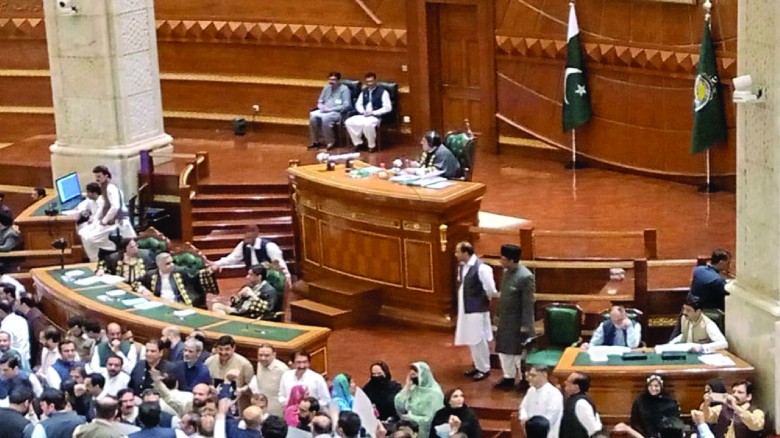
The Punjab Provincial Assembly in Pakistan on Tuesday accepted a resolution to ban the incarcerated PTI founder and former Prime Minister Imran Khan and his party, labeling them as ‘anti-state.’ Dawn reported this information.
This decision comes days after the Director-General of Inter-Services Public Relations (ISPR), Lieutenant General Ahmed Sharif Chaudhry, attacked Khan for creating and spreading ‘anti-army’ narratives, stating that such narratives are no longer within the sphere of politics but have become a ‘national security threat.’
Since then, a war of words has continued between the ruling Pakistan Muslim League-Nawawz (PML-N) and the PTI leadership regarding that press conference.
Defence Minister Khawaja Asif stated that Imran had used ‘harsh language’ against members of the opposition in the past. He emphasized that the PTI has no right to object to the comments made by the army spokesperson. On the other hand, the opposition party strongly condemned the military spokesperson’s ‘ridiculous’ comments against former Prime Minister Imran Khan, saying he is ‘not a national security threat.’
PML-N MPA Tahir Parveiz introduced the resolution in the Assembly. The motion was passed by the votes of the Treasury Benches members after PTI lawmakers boycotted the session. The resolution did not directly name the PTI or its founder, Imran.
The resolution stated: ‘The institutions that protect Pakistan on all fronts and have successfully confronted an enemy five times larger, like India, are crucial for the integrity and stability of the country.’
It further said that ‘a political party and its founder should be banned for acting as a tool of the enemy state. There are also allegations against him of making anti-state statements and spreading chaos.’ The resolution demanded that action be taken against leaders of any party—whether political or non-political—under the law, and that they be given ‘appropriate punishment.’
It paid tribute to the members and leadership of the institutions working for the stability and security of Pakistan. Earlier, in early $2024$, the Federal Government decided to ban the PTI and initiated proceedings to charge Imran, former President Dr. Arif Alvi, and former National Assembly Deputy Speaker Qasim Suri under Article 6 of the Constitution.
This move was perceived as an attempt to prevent the PTI from becoming the single largest party in the National Assembly following the Supreme Court’s verdict in the reserved seat case.
However, the government ultimately did not enforce that ban. In October, the Federal Government approved a ban on the religious political party Tehreek-e-Labbaik Pakistan (TLP) under the Anti-Terrorism Act (ATA) following violent protests.
However, banning political parties is not a new phenomenon in Pakistan. This practice has been ongoing for decades in the country—ranging from periods of military rule to the so-called democratic system.