- More
Khaled Saifulla 1 Dec 2025 , 1:54 PM Print Edition
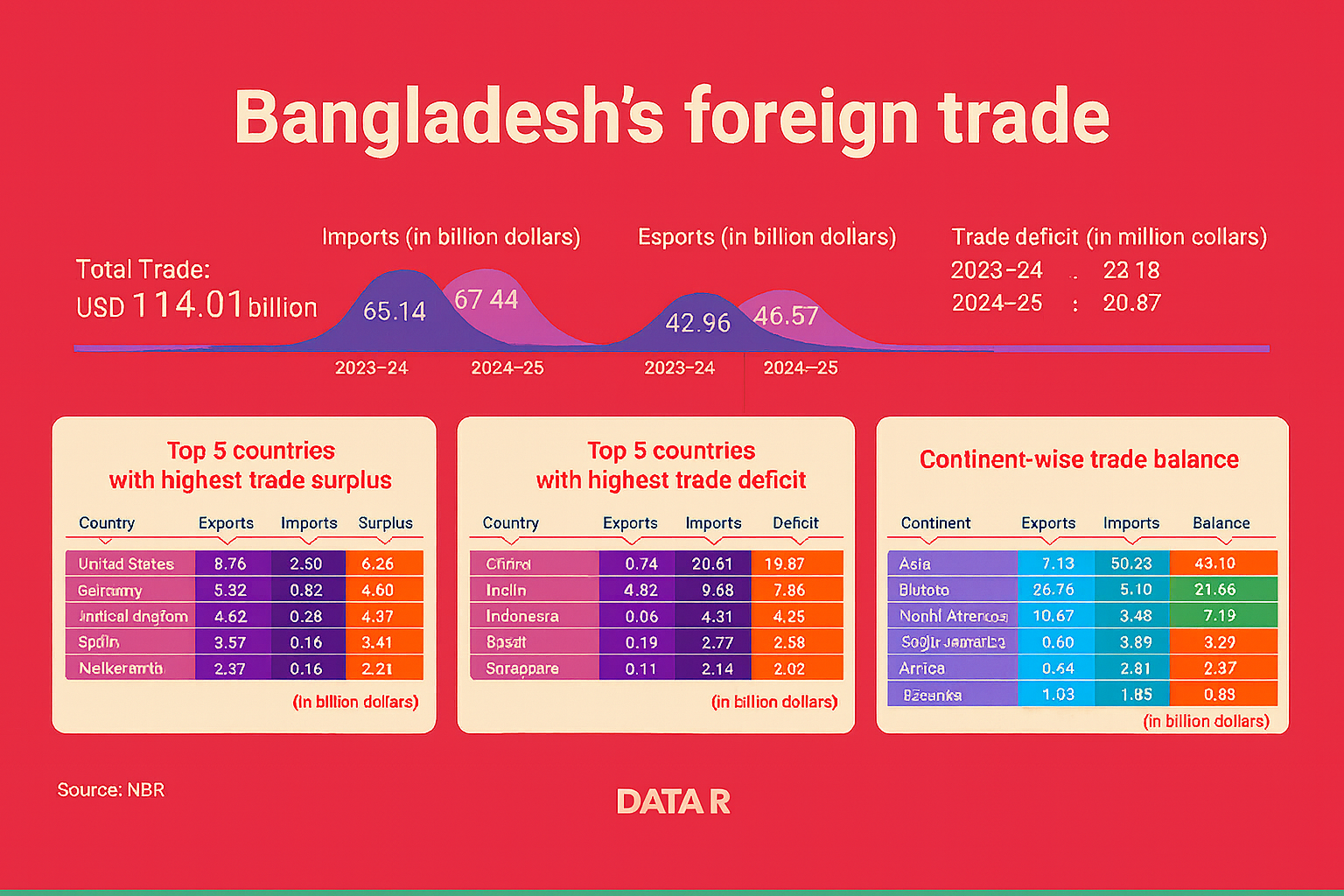
Despite achieving significant export success in North America and Europe, Bangladesh concluded the 2024–25 financial year with a substantial foreign trade deficit of $20.87 billion (Tk 2,087 crore).
An analysis of bilateral trade data from the National Board of Revenue (NBR) reveals a persistent global imbalance: while Bangladesh recorded a trade surplus with 122 countries, the magnitude of deficits with 104 countries—particularly in Asia—far exceeded these gains.
The country’s total foreign trade volume reached approximately $114.02 billion (Tk 11,402 crore), with exports totaling $46.57 billion and imports reaching $67.44 billion.
The NBR data highlights a stark continental divide in Bangladesh’s trade balance:
| Region | Exports (in USD billion) | Imports (in USD billion) | Trade Balance (in USD billion) | Key Drivers |
| Europe | $26.76 | $5.10 | + $21.66 (SURPLUS) | Driven by Ready-Made Garments (RMG) sector. |
| North America | $10.67 | $3.48 | + $7.19 (SURPLUS) | Strong demand from the US, Canada, and Mexico. |
| Asia | Not stated | Not stated | Significant DEFICIT | Massive imports from China and India. |
| South America | $0.60 | $3.89 | – $3.29 (DEFICIT) | Imports of agricultural products (soybean, wheat). |
| Africa | $0.44 | $2.81 | – $2.37 (DEFICIT) | High dependency on imports. |
The United States remains Bangladesh’s most favourable trading partner, primarily due to its position as the largest single export destination.
Exports to US: $8.76 billion
Imports from US: $2.50 billion
Trade Surplus: $6.26 billion (Highest with any country)
This surplus, sustained by the garment sector, contrasts sharply with the deficit experienced with most Asian nations.
Bangladesh faces its biggest trade hurdles in Asia, driven by heavy reliance on industrial raw materials from its two largest neighbours:
| Partner Country | Exports (in USD billion) | Imports (in USD billion) | Bilateral Deficit (in USD billion) |
| China | $0.74 | $20.61 | $19.87 |
| India | $1.82 | $9.68 | $7.86 |
Analysts from NBR state that imports from China and India often contribute indirectly to export performance, as a significant portion (54% from China, 31% from India) consists of raw materials essential for export-oriented industries like RMG.
Business leaders and policy experts stress that the core issue is Bangladesh’s narrow export base and high import dependency. Ready-made garments accounted for nearly 85 per cent ($39.47 billion) of total exports, with the next largest sector (leather goods) reaching only about 2 per cent.
Mustafizur Rahman (Distinguished Fellow, CPD):
“A country may have a surplus with some nations and a deficit with others, but the goal should be a surplus in overall foreign trade… We must focus on expanding exports to markets where our imports are high, such as South Asia, East Asia, and ASEAN countries.”
Amirul Haque (Managing Director, SEACOM Group):
“Two things are essential to reduce the trade deficit: The government must improve negotiation capacity at the policy level… and ensure entrepreneurs’ rights, such as uninterrupted gas and electricity supply, which would help industries grow and diversify exports.”