- More
admin 2 Aug 2026 , 10:36 AM Print Edition
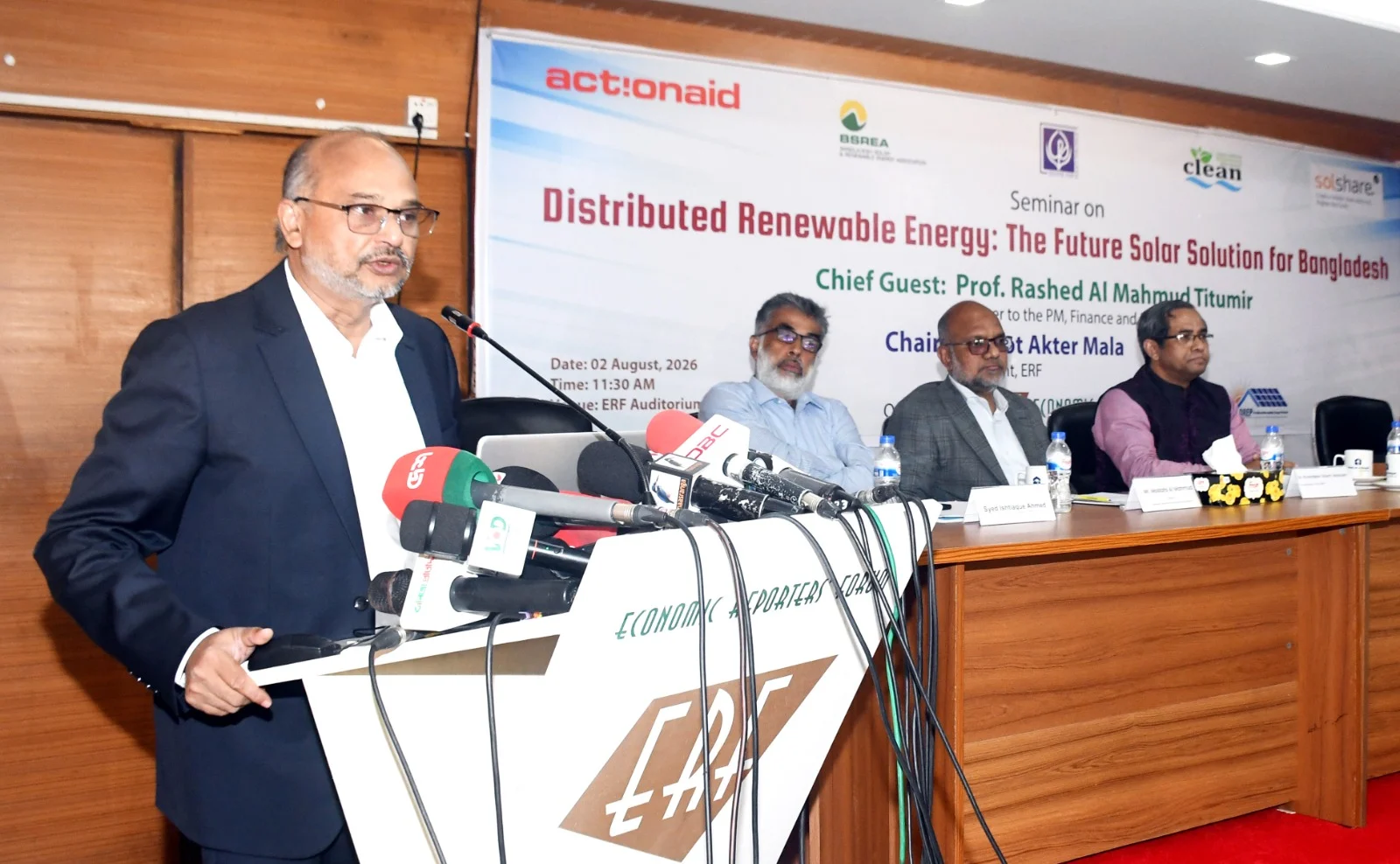
Online Desk : Prime Minister’s Adviser on the Ministries of Finance and Planning, Prof Dr Rashed Al Mahmud Titumir, today called for a nationwide social movement in support of renewable energy, expanded local manufacturing of solar technologies and a balanced energy mix to accelerate Bangladesh’s transition to clean energy and strengthen long-term energy security.

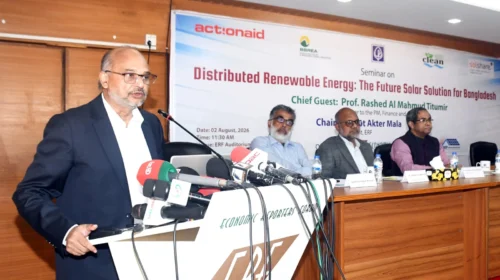
Speaking at a seminar titled “Distributed Renewable Energy: The Future Solar Solution for Bangladesh” at the Economic Reporters’ Forum (ERF) auditorium in the capital, Titumir said Bangladesh must go beyond policy commitments and encourage broad public participation to make renewable energy a people’s movement.
“The first task is to create demand through a social movement. Once citizens articulate that demand, the market will naturally respond with supply,” he said, adding that collective action is essential to protecting nature, biodiversity and the environment for future generations.
Referring to Bangladesh’s history of successful public campaigns, including the mass literacy movement, canal excavation programmes and the Expanded Programme on Immunization (EPI), the adviser said citizen participation has the power to drive national transformation.
He urged civil society organisations, NGOs and microfinance institutions to lead a nationwide campaign promoting renewable energy adoption, describing access to clean energy as a right that should be available to every household.
Titumir said greater use of renewable energy could lower household expenses, increase savings and create new investment opportunities, helping families break the cycle of inherited poverty.
Highlighting the country’s dependence on imported fuel, he encouraged the expansion of household-level renewable energy solutions, including solar-powered cooking systems, to reduce pressure on gas supplies and liquefied petroleum gas (LPG) imports.
“The transition to renewable energy is not merely an environmental necessity; it is also an economic strategy that can strengthen household resilience and national self-reliance,” he said.
The adviser also stressed the importance of developing a strong domestic manufacturing base for renewable energy technologies, saying Bangladesh should produce photovoltaic (PV) panels, batteries, inverters and other solar power components locally instead of relying heavily on imports.
According to him, local manufacturing would strengthen supply chains, generate employment, encourage technological innovation and make renewable energy more affordable for consumers.
He noted that Bangladesh, as South Asia’s second-largest economy and one of the world’s largest consumer markets by population, has the capacity to build a competitive renewable energy manufacturing industry.
Citing Pakistan’s rapid expansion of distributed solar systems, Titumir said Bangladesh could progress even faster with stronger public participation and greater private-sector investment.
Calling for a balanced energy strategy, he said renewable energy should gradually account for a larger share of the country’s energy mix while conventional energy sources continue to play a role during the transition.
He said increased reliance on renewable energy would reduce import dependence, strengthen energy security and help Bangladesh respond to global challenges such as geopolitical conflicts, supply chain disruptions and climate-related risks.
“Uncertainty has become the new global normal. Bangladesh must move from a culture of dependence to a culture of self-reliance,” he said.
Titumir said the government has already introduced fiscal incentives, including tax and duty benefits, to encourage investment in solar energy technologies as part of a broader shift in renewable energy policy.
He also urged microfinance institutions to include renewable energy financing in their lending programmes, saying affordable financing would accelerate the adoption of distributed renewable energy technologies, particularly in rural areas.
The adviser said Bangladesh Bank’s refinancing schemes and other financial mechanisms could play a key role in expanding access to renewable energy, adding that the government is prepared to introduce additional policy support if needed.
The seminar was jointly organised by the Economic Reporters’ Forum (ERF) and the Distributed Renewable Energy Platform (DREP). ERF President Doulot Akter Mala chaired the programme, while DREP Coordinator Dr Khondaker Golam Moazzem moderated the discussion.
Representatives from the Centre for Policy Dialogue (CPD), Bangladesh Sustainable and Renewable Energy Association (BSREA), CLEAN, SOLshare and ActionAid Bangladesh also spoke at the event, discussing policy reforms, financing, energy storage, public awareness and technological innovation to advance distributed renewable energy in Bangladesh.
During the programme, CPD launched its “Renewables in Bangladesh” website as an information and knowledge platform for the country’s renewable energy sector.