- More
admin 1 Aug 2026 , 3:32 PM Print Edition
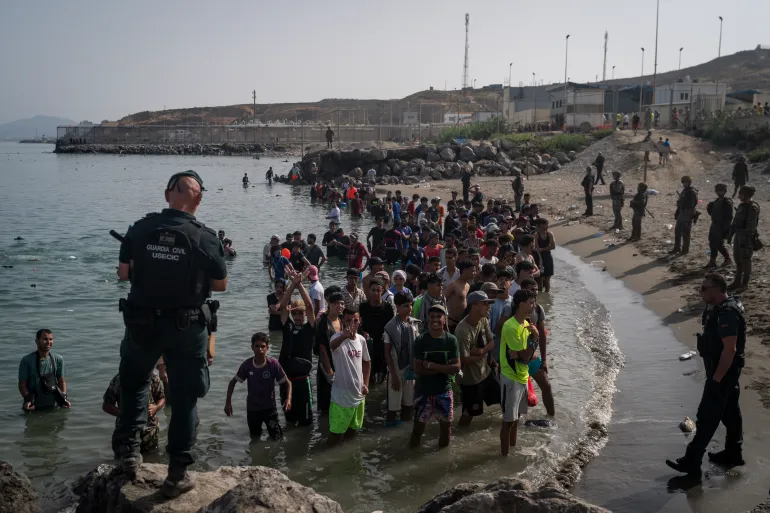
International Desk : Spanish authorities say nearly all migrants who recently entered the North African enclave of Ceuta during a mass border crossing have now returned to Morocco, as officials continue to assess the aftermath of the incident that claimed at least 67 lives.
According to Spanish officials, at least 67 people died while attempting to reach Ceuta, with some drowning and others being crushed while trying to scale the breakwater and border fence. Authorities also warned that the death toll on the Moroccan side of the border could be higher.
Spain’s Foreign Minister, Jose Manuel Albares, said on Friday night that “virtually all” of those who had entered Ceuta had already gone back to Morocco voluntarily.
The large-scale influx of migrants has prompted concern across the European Union, particularly among countries in the Schengen area, where internal border controls have largely been abolished.
European Commission President Ursula von der Leyen described images from Ceuta as “unacceptable,” while French Interior Minister Laurent Nunez announced that France would strengthen border controls with Spain.
Italian Prime Minister Giorgia Meloni also warned that Italy could suspend its Schengen arrangements with Spain in response to the situation, despite the two countries not sharing a land border.
Spain’s Interior Ministry said approximately 50,000 migrants crossed into Ceuta from Thursday onward, with around 48,300 returning to Morocco by Friday evening. However, Ceuta regional leader Juan Jesus Vivas estimated that the total number of crossings may have reached 60,000.
Prime Minister Pedro Sanchez, who visited Ceuta on Friday, described the mass crossing as a violation of Spain’s territorial sovereignty.
Spanish authorities have since begun installing a containment barrier extending into the sea alongside the breakwater to strengthen border security.
On the Moroccan side, police equipped with riot gear used tear gas and water cannons on Friday night to disperse crowds gathered near the border fences.
One young Moroccan man from Tangier told Reuters that he had decided to return home after the failed attempt.
“Honestly, I don’t even know why I came, and now I’m going back,” he said, adding that he had not eaten since the previous day despite carrying some money.
Ceuta and the nearby Spanish enclave of Melilla represent the European Union’s only land borders with Africa and frequently experience attempts by migrants seeking entry into Europe.
Many migrants attempt to reach Ceuta by swimming from the Moroccan town of Fnideq, while others try shorter routes from Belyounech.
Local authorities linked the recent surge to a Spanish Supreme Court ruling that prevents the immediate return of migrants intercepted after arriving by sea. The ruling does not apply to migrants who enter Spain over land by crossing the border fence.
Prime Minister Sanchez blamed criminal smuggling networks for spreading misleading information about the court decision and encouraging people to attempt the dangerous crossing.
However, activists in Morocco questioned that explanation, arguing that many migrants were unlikely to have known about the legal ruling.
Although security measures significantly reduced crossings by Friday evening, groups of migrants were still seen moving along the coastline searching for alternative routes into Ceuta.
“I was late,” said 32-year-old Brahim from Tangier, explaining that he reached the border hoping to cross but found access effectively closed.