- More
admin 5 Aug 2026 , 10:09 AM Print Edition
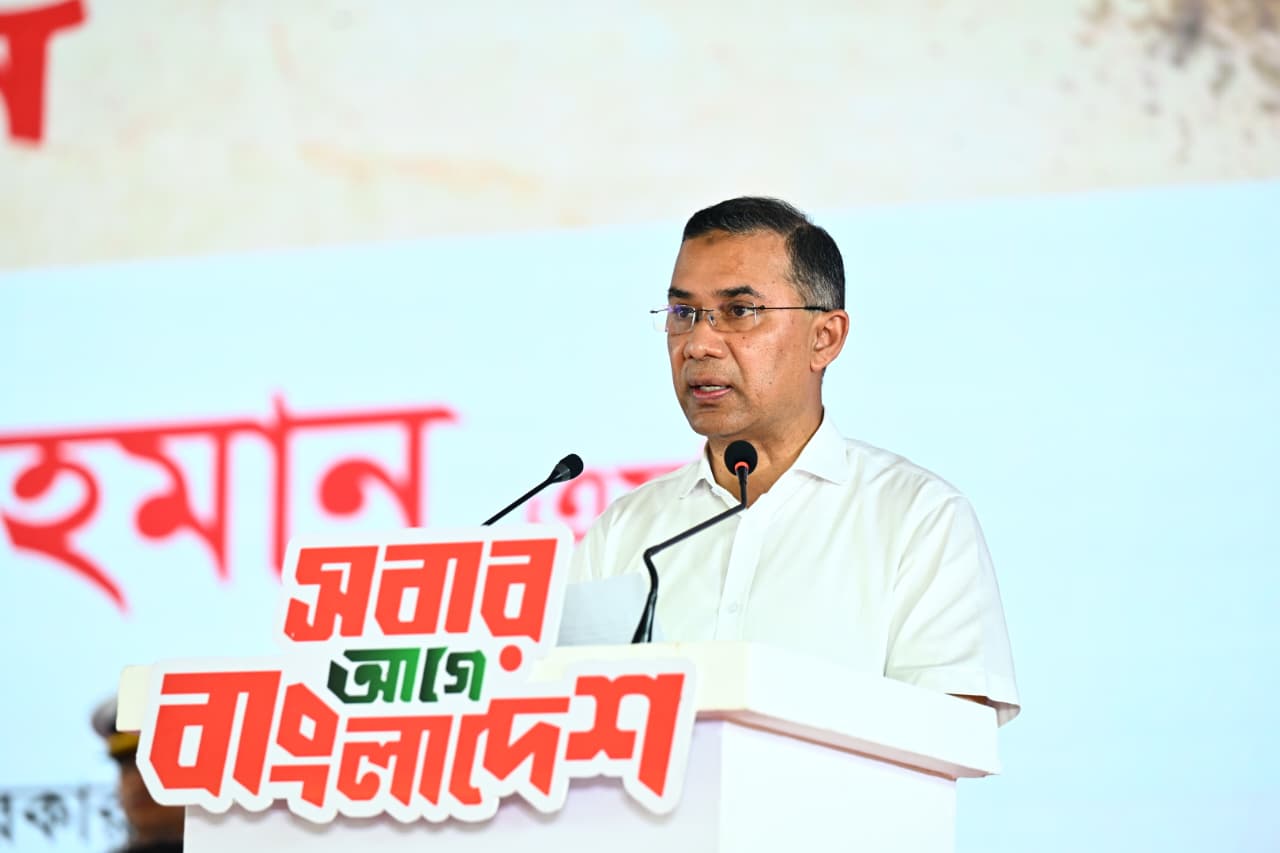
Online Desk : Prime Minister Tarique Rahman today said that those involved in killings during the anti-fascist movement will be brought to justice through transparent, impartial and credible legal proceedings in line with due process.
“The perpetrators of killings during the anti-fascist movement will face trial in a transparent, impartial and credible manner under due process of law. Ensuring justice for every crime is essential to uphold the rule of law,” he said.
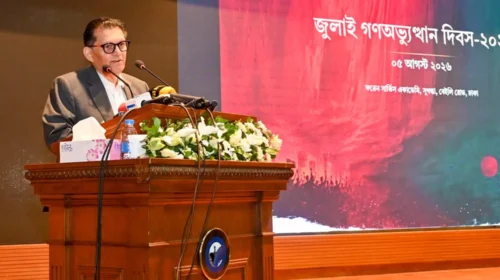
He made the remarks while addressing a discussion titled ‘July-36’ after inaugurating the July Mass Uprising Memorial Museum at Ganabhaban in the capital’s Sher-e-Bangla Nagar this morning.
The prime minister said the government has decided to name institutions after individuals who were killed or became victims of enforced disappearance and other forms of violence over the past 17 years, including those linked to the July Mass Uprising.
“An institution in each locality will be named after every person who was martyred or became a victim of enforced disappearance or killing during the past 17 years and the July movement,” he said.
Referring to the newly opened museum, Tarique Rahman said it must reflect the collective memory of the people and remain free from the influence of any single political narrative.
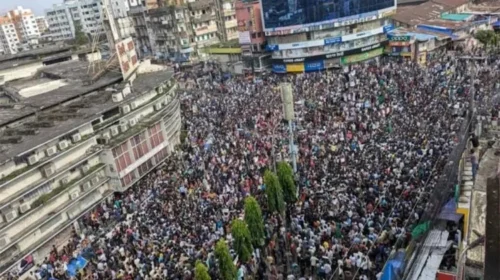
“The 2024 mass uprising did not belong to any individual, group or political party. The real heroes of this uprising are the democratic people of Bangladesh,” he said.
Drawing a comparison between two major historical events, he said the Liberation War of 1971 was fought to achieve independence, while the 2024 mass uprising was aimed at protecting that independence and the people’s democratic rights.
“Just as the nation remembers the freedom fighters of 1971, it will also remember those who sacrificed their lives in 2024 to defend the country and its freedom,” he added.
Warning against political instability, the prime minister urged all sides to act responsibly and avoid unnecessary controversy.
“I urge everyone to consider whether creating unnecessary issues in a post-fascist Bangladesh may unintentionally open the door for the return of defeated authoritarian forces,” he said.
Recalling what he described as over 15 years of authoritarian rule, Tarique Rahman said the country had endured severe human rights violations during that period.
“Today marks another milestone in Bangladesh’s democratic journey. Over the past one and a half decades of the anti-fascist movement, thousands were subjected to enforced disappearance and abduction,” he said.
“Millions faced repression, harassment, attacks and false cases, forcing many to live away from their homes for years. During the July-August mass uprising alone, thousands of students, citizens, women and children were martyred,” he added.
He further alleged that during the July-August uprising, fascist forces used helicopters to open fire on pro-democracy protesters.
He described such actions as unprecedented in the modern world, claiming that enforced disappearances, killings and abductions had become systematic during the previous regime.
“The level of brutality witnessed over the past one and a half decades can only be compared to the three-and-a-half years of misrule after independence,” he said.
Highlighting the importance of the July Mass Uprising Memorial Museum, the prime minister said it would preserve the nation’s struggle and sacrifices for future generations.
“This museum will also expose the true nature of the ousted fascist forces to the new generation,” he said.
He described the museum as a historic initiative that would preserve the stories of struggle, sacrifice, courage and democratic aspirations of the people.
“I hope it will not remain only a memorial to the tragic events of 2024. It should also reflect the broader democratic journey of Bangladesh and its people,” he said.
“The history of all democratic movements and struggles in Bangladesh should be preserved here, not just the July Mass Uprising,” he added.
Tarique Rahman said the ousted authoritarian forces had never accepted democratic governance and claimed that democracy had been undermined through constitutional changes in 1975.
He said Shaheed President Ziaur Rahman, whom he described as the proclaimer of independence, later restored multi-party democracy in the country.
“Preserving these chapters of history will benefit future generations,” he said.
Emphasising historical accuracy, he warned against distorted or politically motivated narratives.
“Incomplete or biased accounts weaken historical credibility and create divisions. Therefore, factual accuracy must be ensured in all documentation,” he said.
He also suggested that museum content be made available in English and other languages alongside Bangla to make it accessible to international audiences.
On rehabilitation of injured July fighters, the prime minister said the government has ensured free treatment in public hospitals.
He added that critically injured individuals are being sent abroad for advanced medical care in countries including Thailand, Singapore, Türkiye and Russia.
“At present, 50 July fighters are receiving treatment abroad. More than 13,000 gazetted fighters are receiving monthly allowances directly in their bank accounts,” he said.
He reaffirmed the government’s commitment to supporting the families of those killed and injured in the anti-fascist movement.
Tarique Rahman also said that alongside financial assistance, efforts are underway to implement long-term reforms envisioned by the martyrs.
“As part of this process, implementation of the 31-point election manifesto and the July Charter has already begun in phases to rebuild the country,” he said.
He added that the parliamentary Special Committee on Constitutional Amendment has also started work to reflect the aspirations of the referendum.
“Through rebuilding the country, we will, InShaAllah, establish a self-reliant, prosperous, secure and democratic Bangladesh—the Bangladesh envisioned by the martyrs,” he said.
Concluding his speech, the prime minister thanked the Bangladesh Army for supporting the people during the mass uprising and expressed condolences to the families of the martyrs.
“Bangladesh will never again become a subservient state,” he said.