- More
admin 5 Aug 2026 , 12:41 PM Print Edition
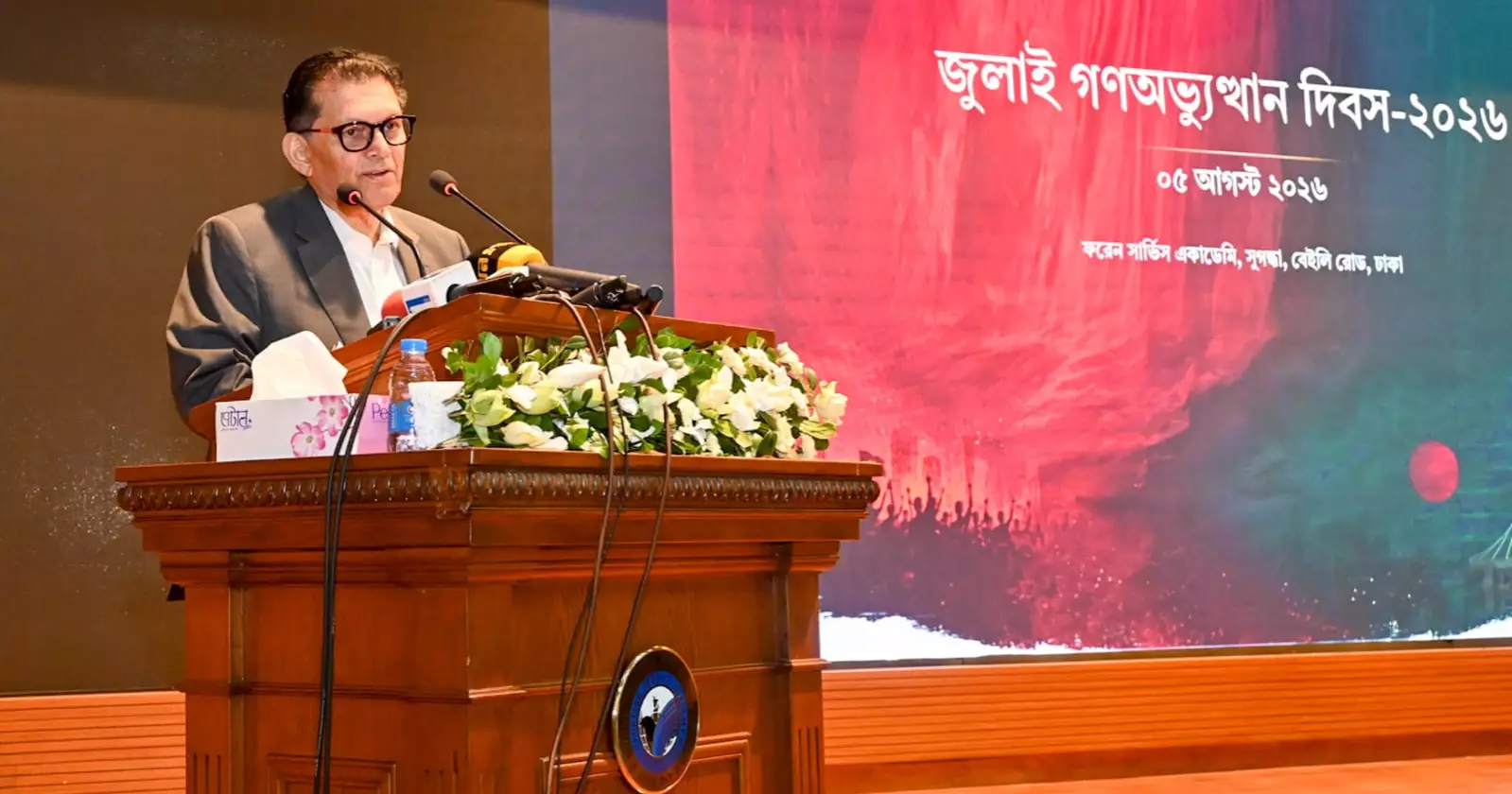
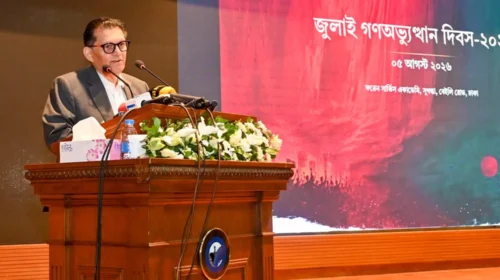
Online Desk : Foreign Minister Dr Khalilur Rahman on Wednesday said Bangladesh must never again become a “client state,” stressing that the country’s post-July foreign policy is guided by a “Bangladesh First” approach aimed at protecting its sovereignty in an increasingly complex global landscape.
Speaking as the chief guest at a programme marking July Mass Uprising Day, the foreign minister said one of the movement’s key achievements was the determination to ensure Bangladesh would no longer be dependent on or influenced by external powers.
Secretary (East & West) at the Ministry of Foreign Affairs Dr Md Nazrul Islam and Foreign Service Academy Rector Muhammad Abdul Muhith also addressed the event, held at the Foreign Service Academy. The programme began with a one-minute silence in memory of those who lost their lives.
Referring to Prime Minister Tarique Rahman’s remarks at the inauguration of the July Memorial Museum earlier in the day, Dr Khalilur said the July movement had reaffirmed the country’s resolve to maintain an independent foreign policy.
“One of the biggest achievements of the July movement is that we do not want to see Bangladesh as a client state,” he said.
Recalling the violence of August 1, 2024, the foreign minister said he had contacted the office of the United Nations Secretary-General after being deeply disturbed by reports of what he described as serious human rights violations.
He said he urged the UN chief not to remain silent in the face of the situation.
“We informed him that such grave human rights violations could not be ignored. We later saw that at least some of the forces stopped firing, and I believe the changes we were trying to accelerate played a role,” he said.
Dr Khalilur said the government’s foreign policy has consistently been guided by a single principle.
“From the very beginning, the cornerstone of our foreign policy has been ‘Bangladesh First.’ We will never return to being a client state—never again,” he said.
He added that the Foreign Ministry has a leading role in safeguarding the country’s independence and ensuring that Bangladesh never returns to such a position.
Reflecting on the July Uprising, the foreign minister described the crackdown as the darkest period in Bangladesh’s history since independence.
“It was the most brutal period in the country’s history since independence—a dark chapter unlike anything we had witnessed before,” he said.
Dr Khalilur also said Bangladesh’s standing on the international stage had improved significantly following the political transition, recalling remarks made by Türkiye’s foreign minister during a recent meeting.
“We are very happy to see Bangladesh coming back after it was once disappearing from the international arena,” he quoted the Turkish foreign minister as saying.
According to Dr Khalilur, the remark reflected Bangladesh’s renewed confidence and independent voice in global affairs.
He, however, warned that the country must carefully navigate an increasingly uncertain international environment marked by growing challenges to multilateralism and the gradual erosion of the post-World War II rules-based order.
“We are facing a complex regional and global reality. Multilateralism is under increasing pressure, and we must navigate these challenges with prudence,” he said.
Highlighting what he described as one of the government’s early diplomatic achievements, Dr Khalilur referred to Bangladesh’s decision to contest the election for the presidency of the UN General Assembly despite significant challenges.
He said the prime minister had insisted that Bangladesh remain in the race despite the odds, describing it as “almost a mission impossible.”
According to the foreign minister, Bangladesh’s eventual victory demonstrated the country’s diplomatic capability and growing confidence.
“The Foreign Ministry passed its first major test, and it was a very difficult one,” he said.
Dr Khalilur said the sacrifices made during the July movement placed a lasting responsibility on state institutions, particularly the Foreign Ministry.
“We are walking on their blood. Let us never forget that responsibility,” he said, referring to those killed and injured during the movement.
He concluded by urging officials to keep Bangladesh’s sovereignty, independence and national interests at the centre of the country’s foreign policy.
“We will never go back to that client state,” he said.